Opening a dialogue on climate change in culture
The workshop began with Gwendolenn’s insightful presentation on the impacts of climate change and adaptation strategies tailored for the cultural and creative industries (CCIs). This was followed by an enriching discussion where participants shared their own experiences and challenges. The session concluded with valuable insights into practical approaches, tools, and resources that cultural organisations can use to adapt to climate change. The importance of collaboration, contingency planning, and consistent implementation of sustainable practices was strongly emphasised.
Understanding adaptation in cultural sectors
Early in the workshop, Gwendolenn highlighted that while mitigation efforts often take centre stage, adaptation to climate change deserves equal attention. She outlined the current trajectory of global warming, its accelerating pace, and possible future scenarios. Her presentation underscored the necessity for CCIs to fully grasp climate impacts and to proactively adapt to these emerging realities.
Mitigation and adaptation: essential strategies for action
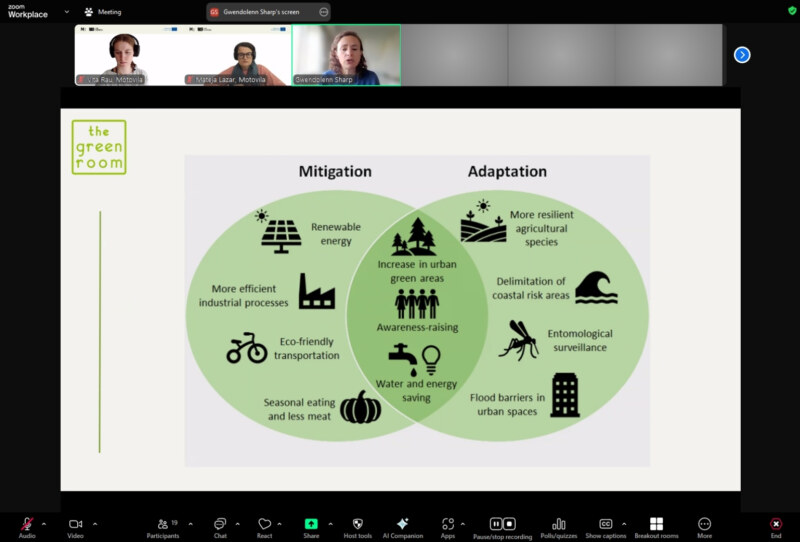
Gwendolenn provided a clear overview of climate risks and explained the distinction between mitigation—addressing the causes of climate change—and adaptation—addressing its consequences. She stressed that effective action requires focus on both fronts. To illustrate, she shared examples such as cultural festivals being cancelled due to extreme weather events. A key concept introduced was that of co-benefits, where sustainability actions yield positive outcomes across environmental and social dimensions. She also emphasised the significance of local, territory-specific adaptation measures and the active involvement of communities in shaping climate responses within CCIs.
Challenges and opportunities in greening cultural events
A lively discussion followed, where participants openly exchanged the challenges they face in implementing green policies and organising environmentally friendly events. Many shared their personal connections to climate change, deepening the conversation. The group also addressed the growing risks and financial challenges posed by extreme weather, including increasing difficulties in insuring cultural festivals. Experiences related to adaptation during the COVID-19 pandemic were also shared, highlighting how overlapping crises affect cultural sectors.
Sustainable solutions and cooperation in cultural institutions
Gwendolenn recounted her visit to Berlin, showcasing inspiring examples such as green roofs and solar panel installations that contribute to sustainable electricity generation. Participants identified hurdles like limited resources and ageing infrastructure that complicate green initiatives. The discussion highlighted the crucial role of collaboration—with local authorities, property owners, and partner organisations—in successfully adapting to climate change. Gwendolenn also introduced a range of valuable resources and policy frameworks, including reports from the United Nations, OECD, and initiatives like Culture for Climate Scotland.
Tools and approaches for effective adaptation in culture
Several practical tools and methods for assessing and managing climate risks in CCIs were presented. Among these was the mobility decision-making tool developed within the On the Move network, which encourages thoughtful choices beyond just transport modes. Gwendolenn stressed the importance of contingency planning for scenarios such as power outages. She also shared examples from France, where projects explore future scenarios for music industries and cultural centres operating with limited resources. Additionally, initiatives tackling sea level rise and its effects on cultural heritage sites were discussed.
The role of culture in raising awareness and driving climate action
In the final part of the workshop, participants reflected on the challenge of sustaining public awareness and momentum around climate change. They noted how quickly people tend to forget about extreme weather events and emphasised the need for strong political commitment. The group agreed on the vital role that cultural and creative industries play in educating the public and promoting a sustainable future. Gwendolenn shared inspiring examples of engaging youth in climate conversations through storytelling workshops and role-playing activities simulating sustainable festival organisation.
Together for a sustainable and adaptive culture
The workshop with Gwendolenn Sharp offered rich insights into how climate change affects cultural sectors and presented concrete strategies and tools for adaptation and mitigation. We extend our sincere thanks to Gwendolenn for her expert and inspiring facilitation, and to all participants for their active involvement and valuable contributions that enriched the dialogue.
Together, we can build a more sustainable cultural future!
The Go Green Cinema project – GGC is funded by the European Union through the Small Projects Fund of the GO! 2025 Interreg VI-A Italy-Slovenia 2021-2027 program, managed by EGTC GO.
www.ita-slo.eu & www.euro-go.eu/spf