Website Banner 1800x900 2

State of Culture 2026: culture’s growing recognition, shrinking agency

Culture Action Europe has launched the second edition of its State of Culture report, titled A Demand for Agency, at an online event on 21 October 2026; the Motovila team also joined the event. Written by Elena Polivtseva, the 135-page report offers a biennial overview of cultural policies across Europe and examines how culture’s role and value are understood in European and national policy. Its central concern is agency: whether cultural and creative sectors are able not only to be recognised, but to actively shape the decisions that affect them.

The report builds on the first State of Culture edition from 2024, which focused on the instrumentalisation of culture and informed Culture Action Europe’s contribution to the EU Cultural Compass. The new edition asks what has changed since then. Its answer is ambivalent: culture is now more frequently acknowledged in political discourse, yet the cultural and creative sectors remain fragile, under-resourced and exposed to competing pressures; from funding cuts and precarious working conditions to technological change and polarised public debate.

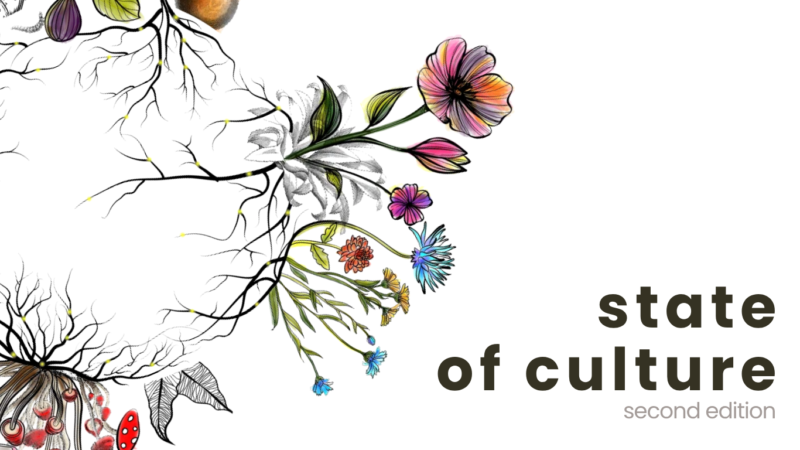
Cover photo: Culture Action Europe


Among its nine observations, its author, Elena Polivtseva, highlighted three particularly urgent issues. First, culture needs active recognition in areas such as sustainable development, democracy and artificial intelligence, rather than symbolic references. Second, trust between the cultural sector and European cultural policy needs to be restored: culture is often praised as vital to democracy, yet it is not consistently supported or given real influence in policymaking. Third, cultural policy may be entering a new phase, focused more strongly on the conditions that make culture possible: fair working conditions and social protection for artists, artistic freedom, resilience in times of crisis, the preservation of cultural memory, and the protection of cultural ecosystems as technology and AI reshape the sector.

The report’s red thread is the gap between rhetoric and reality. Culture is increasingly described as essential to democracy, social cohesion and Europe’s future, but it is still often treated primarily as an economic asset or a tool for other policy goals. Speakers argued that culture should instead be understood as a public responsibility and an equal partner in policymaking; one with the capacity to question dominant narratives, propose alternatives and address issues such as solidarity, climate change and technological power.

A recurring message of the launch was that agency is not something the cultural sector can simply wait to receive; it must be exercised. This means collective action, fair practices within the sector, stronger protection of artistic freedom, and a more confident presence in the spaces where cultural policy is made. Culture Action Europe invited readers to continue the conversation through its action groups on AI and digitalisation, artistic freedom and international cultural relations, ahead of further collective reflection at its Central BEYOND conference in Katowice from 2 to 5 June 2027.

Read the full report State of Culture: 2026 Edition here.


Share

Our partners

Zdruzen Logo Slo2
Sl Co Fundedbytheeu Rgb Pos
Ministrstvo Za Kulturo1 380x58
Mnzju
Logo Mol 1